Monday, September 26, 2005
Credit Card Minimum Increasing in Oct.
From SanDiegoReader.com
Next month, people who have held a credit card for some time should get a surprise: each month, they will have to pay 4 percent of the outstanding balance on the card, not 2 percent. This move was dictated by the federal government's comptroller of the currency in 2003. The phase-in for new customers began in the summer, and October is the big month for existing customers. It's not small change. Almost 40 percent of credit-card holders pay only the minimum balance, according to Cardweb.com.
The average household credit-card balance is around $9000, according to Boston's Babson Capital. Previously, families paid a minimum of $180 a month. Now, they will have to pay $360 each month.
With gas at $3.00 per gallon and the credit card minimum increasing in October, Christmas could be a very interesting time for the consumer this year. Look for increased refinancings and home equity extraction next month as consumers tap their home ATMs to compensate.


Greenspan's Bubble Research
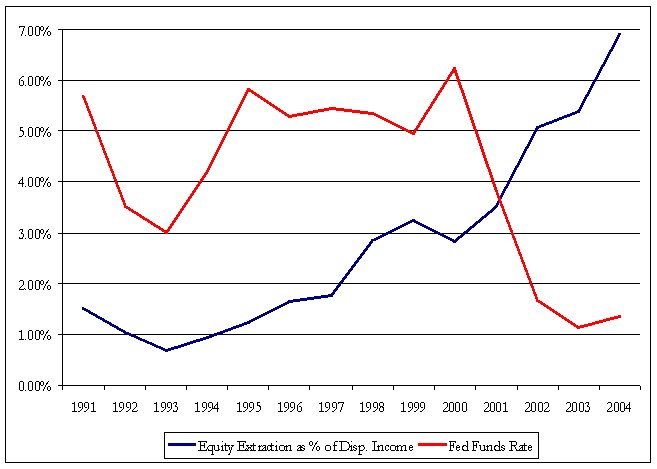
Greenspan appears to be so concerned about the potential economic impact of the housing bubble that he published a research report titled Estimates of Home Mortgage Originations, Repayments, and Debt On One-to-Four-Family Residences about the most nefarious result of the bubble, equity extraction. This is significant because the paper (a collaboration with James Kennedy) marks only the 2nd time in his career as Fed Chairmen Greenspan has published any of his research (the 1st was in 1997 and was on the Auto Industry). Most economists have felt that equity extraction has been driving consumer spending in America, which is driving about 70% of GDP. Now Greenspan has provided the research that proves it. Of course, the Fed has no one to blame but themselves for this Equity Extraction bubble, as the graph shows (and we all know intuitively) that Equity Extraction is inversely correlated with the Fed Funds rate. It is scary to think what may happen to the economy if the Equity Extraction does slow.
Friday, June 17, 2005
Trillion Dollar Kablooie
Volume of ARMs Adjusting by Year:
2005: $80 billion
2006: $300 billion
2007: $1 trillion
The 2007 figure according to the NY Times represents 12% of outstanding mortgages.
12% of mortgages adjusting in one year is going to be painful. Even if long term rates remain low, ARMs are predominantly written off short term rates, which have risen dramatically in the past 2 years.
2005: $80 billion
2006: $300 billion
2007: $1 trillion
The 2007 figure according to the NY Times represents 12% of outstanding mortgages.
12% of mortgages adjusting in one year is going to be painful. Even if long term rates remain low, ARMs are predominantly written off short term rates, which have risen dramatically in the past 2 years.
Wednesday, June 15, 2005
Durable Good to Asset Class
I believe that the concept of home ownership has fundamentally changed in the United States in the past 3 years. Homes have been transformed from a durable good into an asset class. Historically, a home has been a long lasting durable good. It functioned as a place of shelter, security, and comfort. Homes were purchased for the tangible benefits they provided the owner. Today homes are an asset class. People buy homes because they believe they will receive a return from owning one. Even when someone buy a home for the tangible benefits it provides they still fundamentally believe they can and will make money from owning it. This shift helps to explain why 40% of the homes purchased in 2004 were for second-home or investment purposes. It also explains why transaction volume has doubled in the last few years. You live in a home, but you trade an asset.
Homes are a perverted asset class. Unlike stocks, bonds, or even commercial real estate an occupied home produces no income. And in the hottest markets the income from renting a home does not cover the mortgage payment. Homes are not easily traded and have high transactions costs for doing so. But if enough people see their homes as investments, than homes become an asset class.
If homes are an asset they can lose money, a lot of money and many people can get hurt. If homes are an asset people are going to sell them just like they sell stocks or bonds when they depreciate. This is in sharp contrast to the past when people thought of their homes principally as a place to live and thus a downturn gave them no reason to exit, because a fall in financial value changed nothing about the tangible benefits a home provides (shelter, security, etc.). However, a fall in value changes a lot about the benefits an asset provides (returns). It will be very easy for the investors who bought 40% of homes last year to walk if home values fall, because they don't live in their assets.
Homes are a perverted asset class. Unlike stocks, bonds, or even commercial real estate an occupied home produces no income. And in the hottest markets the income from renting a home does not cover the mortgage payment. Homes are not easily traded and have high transactions costs for doing so. But if enough people see their homes as investments, than homes become an asset class.
If homes are an asset they can lose money, a lot of money and many people can get hurt. If homes are an asset people are going to sell them just like they sell stocks or bonds when they depreciate. This is in sharp contrast to the past when people thought of their homes principally as a place to live and thus a downturn gave them no reason to exit, because a fall in financial value changed nothing about the tangible benefits a home provides (shelter, security, etc.). However, a fall in value changes a lot about the benefits an asset provides (returns). It will be very easy for the investors who bought 40% of homes last year to walk if home values fall, because they don't live in their assets.
KB Homes- NO BUBBLE
I saw Bruce Karatz, CEO of KB Homes, speak today at a real estate conference. He explicitly said that there was no bubble and that housing prices have appreciated because of fundamental demographic changes. He completely avoided talking about the impact of interest rates and went as far as saying that sales volume may remain at record levels for the next 20 years. While I think his opinions are preposterous, I understand that as the CEO of a publicly traded home builder there is no way he can say there is a bubble.
He made no mention of any fundamental economic drivers of home price appreciation other than job growth, which he claimed was less than stellar. Bruce also claimed that homes will not drop in value because there has been little over building compared to previous cycles. While most public homebuilders learned their lesson about spec building in the last cycle and have vastly reduced their WIP. The potential for oversupply still exists, if according to the NAR 40% of the new homes in 2004 were sold for investment or second home purchases, these can come back on the market quickly. People do not move out of the homes they occupy if they go down on value, but if their investment properties go down, why would they not get out?
He made no mention of any fundamental economic drivers of home price appreciation other than job growth, which he claimed was less than stellar. Bruce also claimed that homes will not drop in value because there has been little over building compared to previous cycles. While most public homebuilders learned their lesson about spec building in the last cycle and have vastly reduced their WIP. The potential for oversupply still exists, if according to the NAR 40% of the new homes in 2004 were sold for investment or second home purchases, these can come back on the market quickly. People do not move out of the homes they occupy if they go down on value, but if their investment properties go down, why would they not get out?
Monday, May 30, 2005
Mortgage Bankers Bailing Out
I realize this is extremely anecdotal evidence, but since real estate is driven by human emotions I believe it is applicable to my "bubble" thesis. In a prescient move, the Chief Economist of the Mortgage Bankers Association, Douglas Duncan, commented this week that he is selling his home in Washington DC, which has tripled in value in the last twelve years, and is going to rent. Duncan expects, "significant reversals" in regions that have enjoyed strong home price appreciation, including Washington, D.C., Florida and California. If home prices in DC tripling over the past dozen years is disconcerting, than California prices tripling in the last 6 years must by nauseating.
This story brings to mind an axiom that my portfolio management professor gave me: "In every transaction there are three people, a seller, a buyer, and a broker, but only one of them is guaranteed to make money." It is because brokers are guaranteed to make money that they are constant cheerleaders, pushing markets higher and lower, but always demanding more transactions. So it particularly auspicious that the chief economist for the Mortgage Brokers Association is raising the red flag on this out of control market. A person whose principal job is to encourage mortgage transactions sees the market as so wreckless that his ethics and humanity (but more likely desire for self preservation) are overwhelming his role as mortgage lending cheerleader. If the the chief economist for the National Association of Realtors, announces that he sold his house because the market is overheated, than head for the hills because a tidal wave will imminently strike the housing market.
This story brings to mind an axiom that my portfolio management professor gave me: "In every transaction there are three people, a seller, a buyer, and a broker, but only one of them is guaranteed to make money." It is because brokers are guaranteed to make money that they are constant cheerleaders, pushing markets higher and lower, but always demanding more transactions. So it particularly auspicious that the chief economist for the Mortgage Brokers Association is raising the red flag on this out of control market. A person whose principal job is to encourage mortgage transactions sees the market as so wreckless that his ethics and humanity (but more likely desire for self preservation) are overwhelming his role as mortgage lending cheerleader. If the the chief economist for the National Association of Realtors, announces that he sold his house because the market is overheated, than head for the hills because a tidal wave will imminently strike the housing market.
Subscribe to:
Posts (Atom)